RISE, SHINE & TRADEMARK TROUBLE - SCOTUS TAKES UP THE MTN DEW x RISE TRADEMARK BATTLE
Your brand is more than just a logo. It’s your reputation, your story, and oftentimes. . .your competitive edge. But what happens when another company enters the marketplace using a name that seems just a little too familiar? Better yet, who gets to decide whether your trademark is even strong enough to warrant federal protection? The judge...or the jury?
That is the million-dollar question “The Supremes” [United States Supreme Court or “SCOTUS”] are gearing up to answer in one of the most anticipated trademark cases of this season!
I. Rise and Shine. . .or Rise and Sue?
While the dispute centers around PepsiCo's MTN DEW RISE ENERGY and Rise Brewing's RISE coffee beverages, do not let the product labels fool you – this case is brewing something much bigger than a battle over coffee and energy drinks.
At its core, RiseandShine Corp. v. PepsiCo, Inc. asks one of trademark law's most influential questions: how strong is a trademark, and who gets to make that call? The answer could potentially reshape how trademark infringement cases are litigated across the nation. Moreover, it could influence how businesses protect the brands they have worked so hard to build going forward!
For entrepreneurs, creators, and business owners, this case serves as an important reminder that protecting your brand is not just about securing a federal trademark. It is also about understanding how courts evaluate the strength of your mark and whether consumers are likely to confuse your brand with someone else's.
II. The Legal Backdrop
When PepsiCo launched MTN DEW RISE ENERGY in 2021, Rise Brewing argued that consumers may believe the products were connected and filed suit under the Lanham Act for trademark infringement. More specifically, Rise alleged a claim of reverse confusion.
Now, here's where trademark law flips the script. Most people think trademark infringement happens when a smaller business tries to ride the coattails of a household name. Reverse confusion is the complete opposite. It happens when a larger company enters the marketplace with so much brand recognition that consumers begin to think the smaller, original business is actually the copycat.
In other words, the concern was never that Pepsi looked like Rise, the concern was that Rise might eventually look like Pepsi.
Rise Brewing asked the Court to stop PepsiCo from using the MTN DEW RISE ENERGY mark as the lawsuit played out. At first, the District Court agreed. Then came the plot twist!
III. The Second Circuit Hits the Snooze Button
In RiseandShine Corp. v. PepsiCo, Inc., 41 F.4th 112 [2d Cir. 2022], the United States Court of Appeals for the Second Circuit vacated the injunction after concluding that Rise Brewing was unlikely to succeed on the merits of its trademark infringement claim.
Applying the Polaroid likelihood of confusion factors, the Second Circuit focused heavily on two issues:
the conceptual strength of the “RISE” trademark, and
the similarities between the competing marks.
And here’s where the trademark tea really begins to spill. The Court concluded that “RISE” is an inherently weak, suggestive mark. Why? Because the word "Rise" naturally brings coffee, mornings, and energy to mind. Great branding? Absolutely. A particularly distinctive trademark? Not so much!
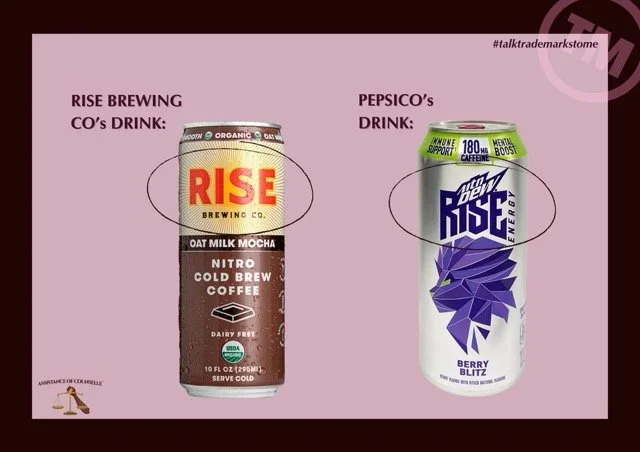
The court also noted that plenty of businesses already use variations of the word, which makes the mark even narrower in scope. Even Rise Brewing's reported $17.5 million investment in advertising was not enough to overcome that conceptual weakness. Aside from both products featuring the word "Rise," the similarities mostly stopped there. Different fonts. Different logos. Different packaging…A completely distinct overall appearance!
According to the Court, sharing one common word was simply not enough to create a likelihood of confusion.
IV. So Why Are The Supremes Getting Involved?
The Supremes aren’t reviewing this case to decide whether or not Pepsi infringed upon Rise Brewing's trademark, they’re are stepping in to answer a much more complex question: “WHO GETS TO DECIDE WHETHER A TRADEMARK IS CONCEPTUALLY STRONG OR WEAK?”
Rise Brewing argues that it’s a factual issue, belonging in the hands of a jury. PepsiCo, on the other hand, argues that it’s a legal question, which has historically been decided by judges. It may sound procedural at the outset, but the answer could essentially change trademark litigation as we know it.
For business owners, creators, and anyone building a brand, this case is about much more than coffee.
It's about deciding who gets to define the strength of your brand before anyone else does.
V. Trademark 101: Why “Likelihood of Confusion?” Is The Real MVP
Let's talk about the legal doctrine driving this entire dispute: “likelihood of confusion”.
Contrary to popular belief, trademark law is not designed to give businesses exclusive ownership over words, colors, or phrases. Its primary purpose is to protect consumers from being misled about exactly who is behind a product or service. Under the Lanham Act, a trademark owner generally must show that another company's use of a mark is likely to cause consumer confusion. See 15 U.S.C. §§ 1114, 1125(a). The law does not actually require proof that consumers were confused. Instead, courts ask whether an ordinary consumer would likely believe the products come from the same source or are somehow connected.
So... how exactly do courts make that determination?
VI. The “Polaroid Puzzle”
Well, there is no secret mathematical formula. The Court must balance several factors that, when considered together, help paint the bigger picture. Those factors, dubbed the “Polaroid factors” derive from the infamous Polaroid Corp. v. Polarad Electronics Corp., 287 F.2d 492 [2d Cir. 1961].
In this case, two factors took center stage:
The Strength of the Plaintiff's Mark: This factor asks a simple question: How distinctive is the trademark? The stronger and more unique a trademark is, the broader the protection it generally receives.
Similarity of the Marks: Courts use this factor to compare the trademarks as the consumer will encounter them. This analysis extends far beyond whether two products share a common word. Courts consider appearance, sound, meaning, font, color, packaging, logos, and overall commercial impression.
That explains why PepsiCo prevailed before the Second Circuit, since the overall presentation of each beverage looked noticeably different.
Overall, the Polaroid factors show that sharing a word alone will not automatically allow for a successful trademark infringement claim.
The Bottom Line?
Whether you're launching a startup, building a personal brand, or managing a growing business, this case is a reminder that a federal trademark registration is only one piece of the puzzle.
A strong trademark is not just memorable, it’s distinctive. As the Supremes prepare to decide who determines a trademark's conceptual strength, businesses should pay close attention. If that question shifts from judges to juries, trademark litigation could become more fact-intensive, more unpredictable, and more likely to reach trial!
Building a brand is about more than choosing a great name. It is about creating an identity that consumers immediately recognize as yours. Not every similar mark will create consumer confusion, but every strong brand has a mark that stands apart.
While all eyes are on The Supremes, keep in mind that standing out isn’t only good branding – it’s good business!