What started as a dispute over a portrait tattoo of Miles Davis has become one of the most closely watched copyright law cases in the Ninth Circuit & beyond. More importantly, it has evolved into a challenge to one of the most longstanding copyright law doctrines.
I. The Legal Backdrop
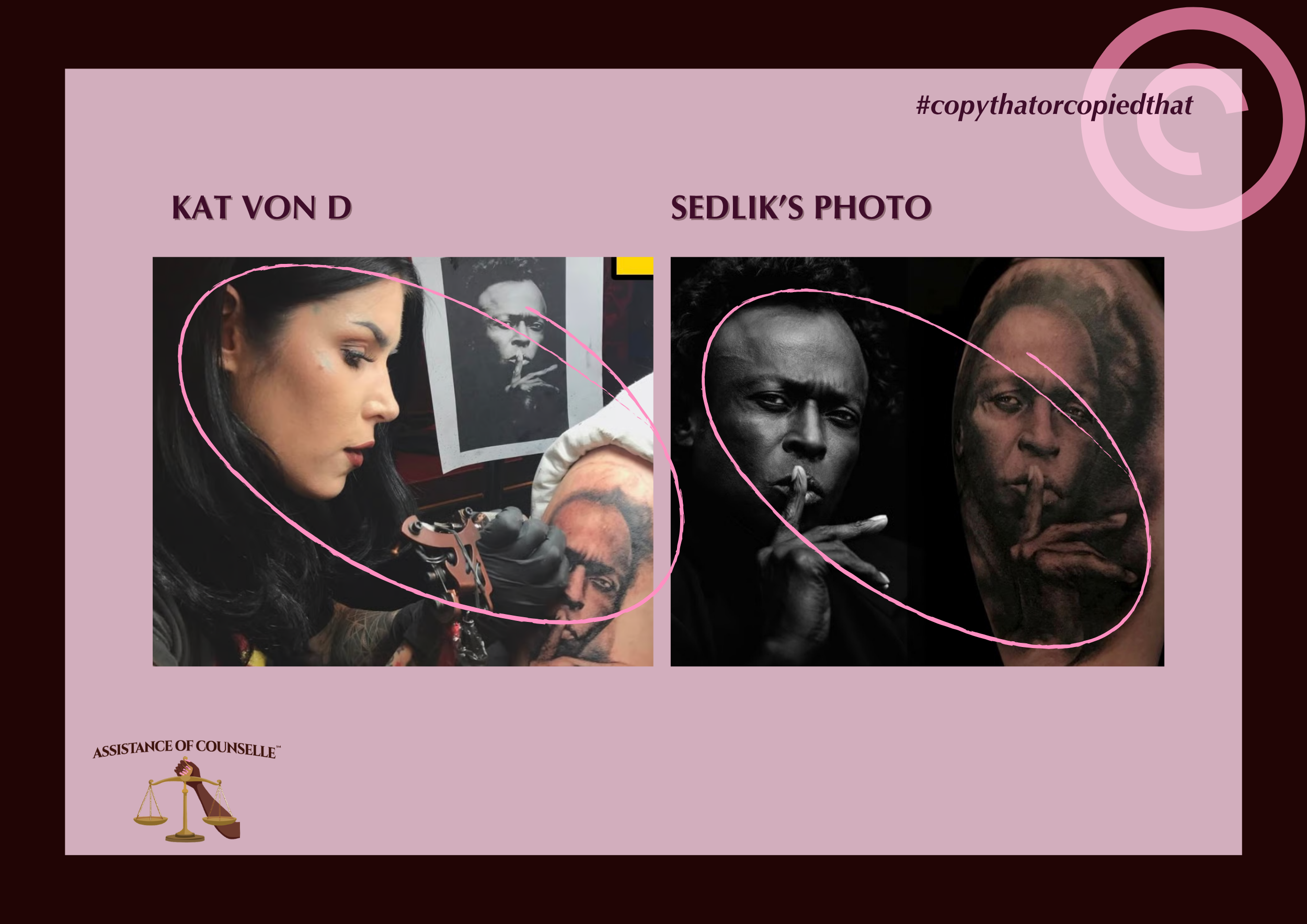
In 2021, professional photographer, Jeffrey Sedlik, sued TV personality, entrepreneur & tattoo artist, Katherine von Drachenberg [p.k.a. Kat Von D] and tattoo shop, High Voltage Tattoo, for copyright infringement after Von D tattooed his iconic 1989 portrait of jazz legend Miles Davis onto a friend [Von D worked directly from Sedlik’s photo, tracing it on a light box to create her stencil for the tattoo] without a license.
Sedlik argued that the tattoo itself, the preparatory sketch, AND social media posts [which depicted the tattoo, the photo, Von D in the process of inking the tattoo & even described the finished tattoo, as “100% exactly the same” as the reference] infringed his copyright. Von D denied copyright infringement and the dispute proceeded to trial, where in 2024, a jury found that the tattoo itself was not substantially similar to the photograph and that the social media posts qualified as fair use and therefore did not infringe Sedlik’s copyright
Post-trial appeals/motions aside, normally, that might have been the end of the matter. Instead, this case exposed deeper concerns about how courts evaluate copyright infringement claims.
When the Ninth Circuit reviewed the jury's verdict in January 2026, a three-judge panel affirmed the outcome. However, two members of that panel, Judges Johnstone and Wardlaw, expressed significant discontent with the legal framework they were required to apply.
In a concurring opinion, Judge Johnstone traced the history of the doctrine & argued that the “intrinsic test” had become "standardless" because it essentially asks jurors to make subjective judgments without providing meaningful legal standards to guide decisions. Judge Wardlaw wrote that she not only fully agreed with Judge Johnstone’s concurrence & his analysis of the court’s extrinsic-intrinsic test for substantial similarity, she further suggested that the “intrinsic test” has fundamental flaws, and that the court should consider dispensing with it altogether.
Both judges seemed to suggest that they might have viewed the infringement question differently [with Johnstone saying it was "an understatement" to say the tattoo was substantially similar to the photograph] and concluded that the existing doctrine left them with little ability to meaningfully review the jury's determination, ultimately questioning whether the doctrine adequately serves modern copyright law.
That criticism proved significant & prompted something RARE, and in June 2026, the Ninth Circuit granted a rehearing, en banc, vacating the earlier decision & agreeing to reconsider the case before a larger panel of judges.
When oral arguments were heard on September 29, the discussion quickly moved beyond the original dispute & instead focused on the continued viability of the Ninth Circuit's longstanding “substantial similarity” framework.
Judges specifically questioned the role of the most controversial component of the framework, the “intrinsic test”, explored whether a more objective standard could better serve copyright law, and expressed a willingness to reconsider the doctrine that has shaped copyright litigation for decades.
II. The Issue Is No Longer the Artwork, It’s the Framework.
At this point, the dispute has evolved far beyond the question of whether a tattoo copied a photo.
During the recent en banc arguments, the Ninth Circuit appeared willing to reconsider a foundational component of its copyright infringement framework: the intrinsic test. That matters because what happens next could affect not only tattoo artists, but photographers, illustrators, designers, creators & anyone whose work exists in visual form.
Under the current framework, courts apply two separate tests — the “intrinsic” & “extrinsic” tests:
The “EXTRINSIC TEST” = the objective analysis used to examine the “substantial similarities” between the protectable elements of two works while filtering out the unprotectable elements.
The “INTRINSIC TEST” = the subjective inquiry that asks whether an ordinary observer would view the two works as substantially similar, sharing the same "total concept and feel."
For decades, this two-part framework has been a fixture of copyright law. The problem, according to its critics, is that the intrinsic test may be too subjective to produce consistent results.
That criticism goes well beyond this particular lawsuit & strikes at a fundamental question of judicial decision-making: if a legal standard depends heavily on intuition, personal perception, or overall impressions, how should appellate courts review the outcome?
III. How Subjective is “Too Subjective”? — Why the Ninth Circuit Appears Concerned About The Intrinsic Test
One of the most notable moments of the en banc hearing came when Judge Consuelo Callahan referred to what she described as the "elephant in the room", referring to the perception among many observers that the tattoo & photograph appear strikingly similar despite the jury's conclusion to the contrary.
The overall concern appears to be less about whether this particular jury reached the correct result and more about whether copyright law, as it stands, provides a framework capable of producing & reviewing that result in a meaningful way.
Copyright law depends on more than just outcomes; it depends on legal standards that can be explained, applied consistently, and reviewed on appeal. Critics argue that the current framework makes those three objectives difficult to satisfy because it relies so heavily on subjective perceptions of similarity.
Folks are not necessarily saying that juries should play no role in copyright cases; rather, the concern is that the intrinsic test, as it stands, gives juries too much unchecked discretion & allows them to make consequential copyright determinations without sufficiently defined legal guardrails in place, ultimately leaving appellate courts unable to meaningfully review similarity findings because their “hands are tied”.
The bigger concern is: if courts, litigants, jurors, and observers can look at the same exact works and reach fundamentally different conclusions, is the problem the evidence, the verdict, or the legal framework being used to evaluate it?
That raises much broader questions, implicating the role of juries, the scope of appellate review, and the degree of predictability that copyright law should provide:
What exactly is a work's "total concept and feel"?;
How should jurors measure it?; and
How can appellate courts meaningfully review a determination and how can copyright law provide predictable outcomes if one of its central inquiries depends largely on personal perception?
Those questions surfaced repeatedly during the en banc hearing & Sedlik’s counsel urged the court to abandon the intrinsic test altogether and replace it with a more objective framework focused on comparing protectable elements of the works at issue. The judges' questions suggested that identifying flaws in the intrinsic test is only the beginning. The more difficult task will be determining what, if anything, should replace it.
Perhaps most telling was the court's willingness to entertain the possibility that the longstanding approach may no longer serve its intended purpose, with the court examining whether the intrinsic test has become so subjective that it creates inconsistent results and frustrates appellate review.
IV. Why This Matters Beyond Tattoos
It’s very tempting to view this as just another dispute involving a celebrity tattoo artist or a photo, but that would be a mistake.
The Ninth Circuit encompasses one of the nation's most significant creative economies. Its substantial similarity framework is applied across a wide range of copyright disputes involving:
photography;
film & TV;
music;
publishing;
software;
gaming;
visual art;
entertainment;
advertising;
digital media;
design; and
other emerging technologies.
Any change to that framework could influence how future infringement claims are analyzed across those industries.
If the court narrows, revises, or abandons the intrinsic test entirely, copyright litigation could become more focused on objective comparisons and the identification of protectable expression. Courts may place more emphasis on analytical reasoning & less emphasis on subjective impressions.
The en banc hearing also revealed that the court is not merely deciding whether to preserve or discard the intrinsic test. Multiple alternatives appear to be under consideration, including narrowing the doctrine, merging it with the objective analysis, or replacing it altogether.
Any of those approaches could affect:
How substantial similarity is evaluated;
How jury instructions are crafted;
How trial courts resolve copyright disputes;
How appellate courts review infringement findings; and
How predictable copyright outcomes become.
At the same time, retaining the current framework would reaffirm the role of juries in evaluating overall artistic impressions, even where “reasonable observers” disagree.
A decision remains pending. Whatever the outcome, the consequences will extend far beyond Sedlik v. Von Drachenberg — this may very well be remembered as the case that forced the Ninth Circuit to reconsider how copyright infringement itself should be evaluated.
The questions raised in this case are not unique to tattoos or photos & the significance goes way beyond the artistic medium involved. They go to the heart of how courts distinguish lawful inspiration from actionable copying.
V. The Challenge of Replacing an Established Doctrine
Criticizing an existing framework is wayyyy easier than replacing one.
The Ninth Circuit is not simply being asked whether the intrinsic test has flaws. It is being asked what should happen if those flaws are deemed significant enough to warrant change. Any change to that framework could influence how future infringement claims are analyzed across a wide range of industries.
If the court narrows or abandons the intrinsic test entirely, future copyright cases may place greater emphasis on objective analysis. Courts could focus more heavily on identifying protectable expression, comparing specific creative elements & articulating clearer reasons for why one work does or does not infringe another. More objective standards may allow courts to resolve disputes earlier, provide clearer guidance to litigants, and give appellate courts a stronger basis for reviewing infringement determinations. They could also reduce some of the unpredictability that accompanies highly subjective jury assessments.
At the same time, retaining the current framework would reaffirm the role of juries in evaluating the overall impression of creative works, even where reasonable observers may disagree about the similarities between them.
Any revised approach would need to balance competing interests, such as:
Protecting copyright owners from unlawful appropriation;
Preserving room for creativity and lawful borrowing;
Providing meaningful guidance to juries;
Allowing effective appellate review; and
Promoting reasonably consistent outcomes across different types of creative works.
Finding that balance has long been one of copyright law's most difficult challenges, which is precisely why this case has attracted so much attention.
Bottom Line? Copyright's Future is Under The Needle
The most consequential cases are often remembered not because of their facts, but because of the legal questions they force courts to confront. This case appears slated to become one of them.
What began as a dispute over a tattoo based on a photograph has evolved into a broader examination of how courts determine when creative similarity and inspiration becomes copyright infringement.
The Ninth Circuit is no longer being asked only whether a tattoo infringed a photograph. It is being asked whether one of the most influential and longstanding infringement tests in copyright law remains capable of delivering the clarity, consistency & reviewability that modern copyright disputes require.
The real significance of this dispute may not be whether a tattoo infringed a photograph.
It may be whether the Ninth Circuit decides that the doctrine it has relied upon for decades can no longer adequately serve the purpose for which it was created.
If the court reaches that conclusion, the lasting impact of Sedlik v. Von Drachenberg will not be found in “tattoo” law. It will be inked in the future of copyright infringement analysis itself.